Tuesday, February 17, 2026

The illusion of sacrifice


1.  PRAYER

Lord Jesus, when you walked the earth,
Your humility obscure your Kingship.

Two silhouettes kneeling before a cross
Your meekness confused the arrogant,
Hindering them from grasping your purpose,
Your nobleness attending to the destitute.
Teach me to model after your eminence,
To subject my human nature to humility.
Grant me with a natural inclination
To never view myself greater than anyone.
Banish all lingering sparks of self-importance
That could elevate me greater than you.
Let my heart always imitate your humility.

Author Unknown

2. MEDITATION 

https://youtu.be/ENYYb5vIMkU?si=8Y_YJiKxpH68GtRi


3. SONG

https://youtu.be/cNffSR_r8us?si=iplkK645b7Hz3HaE


4.  NARRATIVE
Richard Rohr: The Illusion of ‘Sacrifice’
Saturday of the Third Week of Lent | Readings: Hosea 6:1-6; Luke 18:9-14
REFLECTION

Jesus himself quotes twice from this passage from Hosea in Matthew’s Gospel, both times to defend himself from the “holier than thou” types: “What God wants is merciful people, not heroic sacrifices, God wants you to know how love intimately works, and then you can skip your gestures of self-sacrifice” (my paraphrase based on Hosea’s own descriptions in 2:21ff and 8:11ff ).

Jesus popularizes this somewhat neglected phrase in Hosea to defend himself from people who criticize him for consorting with sinners (Matthew 9:13), and again to defend his disciples and himself who are being criticized for not observing the Sabbath and feeding themselves (Matthew 12:7).

Both times he precedes it with a strong imperative or plea: “Go, learn the meaning of these words,” or “If you only understood the meaning of these words.” Well, it is still important that we learn the meaning of these words because much of religion has not. If we can get this, the Gospel of the publican and the Pharisee will quickly explain itself, and you will see that Jesus was an astute teacher, centuries ahead of modern psychology.

The Pharisee is the common heroic “sacrificer.” People do not realize that this gesture largely feeds the ego and one’s sense of self much more than anything else. God does not need it. You need it. Sacrifice is unconsciously an attempt to control God, who does much better without our control. “I fast twice a week, I pay tithes on all I possess…. I am not like the rest of men,” he says. It looks like you are giving to God, country, church, the sports team, so all will undoubtedly admire you for it.

The social payoffs are so ego-inflating, there is no likelihood that “for God and country” thinking will diminish anytime soon. Sacrifice is often good and needed in life to help other people, but too often it is an attempt to build a more positive self-image by distinguishing oneself from others. Note his words, “I give you thanks, God, that I am not like the rest of men, grasping, crooked, and adulterous.” Could the message be much clearer?

Our tax collector friend has apparently “gone and learned the meaning of the words” because from a distance with bowed head “All he did was beat his breast and say, ‘God, be merciful to me, a sinner.’” And then Jesus delivers his stunning conclusion, still stunning today: “Believe me, this man went home from the temple justified before God, but the other did not.” I hope you have observed that Jesus is never upset at sinners! He is only upset with people who do not think they are sinners. The Pharisee is a public holy man who is not holy at all. The tax collector in Israel is a public sinner, with no credits to his name whatsoever, who ends up being the saint.

TODAY’S READINGS

“Go, learn the meaning of the words, what I want is mercy, not sacrifice, knowledge of God, not burnt offerings in the temple.” —Hosea 6:6

“Jesus spoke this parable addressed to those who believed in their own moral superiority and who held everyone else in contempt. Two men went up to the temple to pray, one a Pharisee and the other a tax collector.” —Luke 18:9–10  

AI

Richard Rohr views Lent not as a time for minor sacrifices or willpower, but as a 40-day journey toward profound transformation, surrender, and "unlearning" to die to the false self. Instead of giving up small luxuries, he advocates for letting go of the ego’s need for control, fostering "beginners mind," and embracing radical, sacrificial love

Key Aspects of Rohr's Lenten Perspective:

  • Transformation over Sacrifice: Rohr argues that Lent is about "change" (transformation of consciousness) rather than "changes" (small sacrifices). It is a time to let go of the ego, which he describes as our passing, false self.
  • Surrender and "The Fall": He emphasizes that "deep allowing" or surrender is the most difficult form of sacrifice. He often references the need for a "necessary suffering" or a falling to bring about true spiritual growth.
  • "Wondrous Encounters": Based on his book Wondrous Encounters: Scripture for Lent, Rohr uses daily meditations to encourage encountering God, moving from the small self to the "True Self".
  • Seeing Correctly: He highlights Lent as a time to move away from blindness (sin as a refusal to grow) and toward seeing reality as God sees it.
  • "The Sign of Jonah": Rohr interprets this "sign" as a call to avoid seeking dramatic miracles, focusing instead on the "anti-sign" of quiet, internal, and often hidden transformation.
Rohr frames Lent as a necessary, daily "dying" to our need for control, allowing us to rise to a new, more loving way of living.
5.  MEDITATION 


6.  SHARING

7.  Prayer and Intentions

“Merciful God, all I can give you, and all you ever want, is who I really am. This little woman or little man that I am now gives you back my only and true self.”

8.  SONG


Monday, February 9, 2026

Returning to love


1.  PRAYER

A Prayer for Resting in God's Love

God of Goodness, I come into your presence so aware of my human frailty and yet overwhelmed by your love for me. 
I thank you that there is no human experience that I might walk through where your love cannot reach me. 
If I climb the highest mountain you are there and yet if I find myself in the darkest valley of my life, you are there. 
Teach me today to love you more. 
Help me to rest in that love that asks nothing more than the simple trusting heart of a child.

- Author Unknown2  

2.  MEDITATION


3. Song
https://youtu.be/Als5Paml-AM?si=oX0_Ow8TDMU93xgf


4.  NARRATIVE

Returning to Love

Tuesday, December 30, 2014

Returning to Love
Tuesday, December 30, 2014

T. S. Eliot writes, “We shall not cease from exploration, and the end of all our exploring will be to arrive where we started and know the place for the first time” (Little Gidding, Part V, “Four Quartets”). We return where we began, to the eternal embrace of Divine Love. We were formed by original blessing, but we’ve heard so often the story of “original sin” that we have to be reminded of our beginnings in beauty and union.

Rob Bell shared at CAC’s CONSPIRE event this year how the Christian Creation narrative is uniquely hopeful. The creation poem in Genesis 1 is a “confrontive story,” portraying something radically different than the common creation stories of its time; rather than “violence and destruction,” the Genesis mythos shows “overflowing joy and creativity.” Knowing we began as an expression of God’s desire for relationship allows us to trust that life is headed somewhere good, into new forms of Love making itself known, oneing all things in a whole and expanding universe. As one Pauline translation puts it “The whole of creation is standing on tip toe to see the full revelation of the children of God” (Romans 8:19).

The story ends where it begins: in life and now even in “life more abundantly” (John 10:10). This Life came from “nowhere” (creatio ex nihilo) and now has my name upon it. From death—the small dyings to the False Self and our eventual physical death—comes resurrection into our True Self, who we have been all along but have simply forgotten. As you look back on a year almost ended and forward to a year about to begin, recall the ways in which God has been inviting you to return, again and again, to Love, which is the same as returning to God.


5.  MEDITATION

https://youtu.be/mFGW0EYnRYg?si=UdmS_8HInknnBJ5T


6.  SHARING

https://youtu.be/8QF9hM1MQwc?si=t0ML3ZhveZ9EHlak


7.  PRAYER AND INTENTIONS

Your Love

Bless us with Love, O Merciful God; 
That we may Love as you Love!
That we may show patience, tolerance,
Kindness, caring and love to all!
Give me knowledge; O giver of Knowledge,
That I may be one with my Universe and Mother Earth!
O Compassionate One, grant compassion unto us;
That we may help all fellow souls in need!
Bless us with your Love O God.
Bless us with your Love.

- Author Unknown

8.  SONG

https://youtu.be/mUE1MB5iWOQ?si=R7g3XCKlSgzbJkuC


Tuesday, February 3, 2026

Trust

 1.  PRAYER

Dear Heavenly Father,
As I rise from my sleep and step into this new day, I am reminded of the wisdom You have shared with us in Proverbs 3:5–6:
“Trust in the Lord with all your heart and lean not on your own understanding; in all your ways submit to Him, and He will make your paths straight.”
Lord, today I place my trust in You with all my heart. I acknowledge that my understanding is limited, and I lean on You for guidance and wisdom in all I do.
Help me to rely not on my own understanding but on Your infinite knowledge and love.
As I prepare to face the challenges and blessings of this day, I submit myself to Your will.
I surrender my plans, desires, and ambitions to You, knowing that Your ways are higher and wiser than mine.
I ask for the humility and strength to align my actions and decisions with Your divine purpose.
Lord, please make my paths straight. Remove any obstacles that may lead me astray from Your righteous and loving path.
Grant me the clarity to discern Your will and the courage to follow it, even when it may seem unclear or difficult.
In every moment of this day, I seek Your guidance and presence. Whether in times of joy or trial, help me to remember Proverbs 3:5–6, and may these verses be a constant reminder of Your steadfast love and faithfulness.
Thank You, Heavenly Father, for the assurance that as I trust in You, submit to Your ways, and seek Your guidance, You will lead me on a straight and purposeful path.
With gratitude and love, I commit this day to You, trusting that You are always by my side.
In Jesus’ name, I pray. Amen.

Originally published at http://4foldlove.wordpress.com on October 3, 2023.


2.  MEDITATION 


3.  SONG


https://youtu.be/ZiEqKpN90W4?si=d9ojVgSZtTZmRArU


4.  NARRATIVE

notes on trust by AI. 
TAGS : MORNING WORSHIPRELIGION
Fr. Richard Rohr, OFM, is a Franciscan friar and author who often speaks on theological and spiritual trust, particularly in the context of a "God-soaked future" and the foundational nature of trust in reality
. 
Here are the key aspects of Rohr’s teaching on trust:
  • Trust in a "God-Soaked Future": Rohr emphasizes trusting in a future that is already "chosen from the beginning". He suggests that the "problem was solved at the beginning," implying that Christmas (the incarnation) was already Easter (the resurrection), which allows for a foundational, radical trust in God.
  • Trust as a Foundation: He presents trust as a "rock" upon which life can be built, likening it to a decision to live without the need for absolute certainty.
  • Trust in Reality: For Rohr, trust in God is synonymous with trusting in reality.
  • A "Subject-to-Subject" View: He encourages moving away from viewing the world as "object" and towards seeing it as "subject" (sacrality), which allows one to recognize the divine within all things, fostering a deeper, relational trust.
  • Connection to Surrender: True trust is portrayed as a quiet, confident, and surrendered state, contrasting it with a reliance on personal, often anxious, control. 
Rohr’s perspectives on trust are deeply intertwined with his teachings on the "Universal Christ" and a Franciscan, creation-centered spirituality.  

Fr. Richard Rohr: Trust in a ‘God-soaked future, chosen from the beginning’

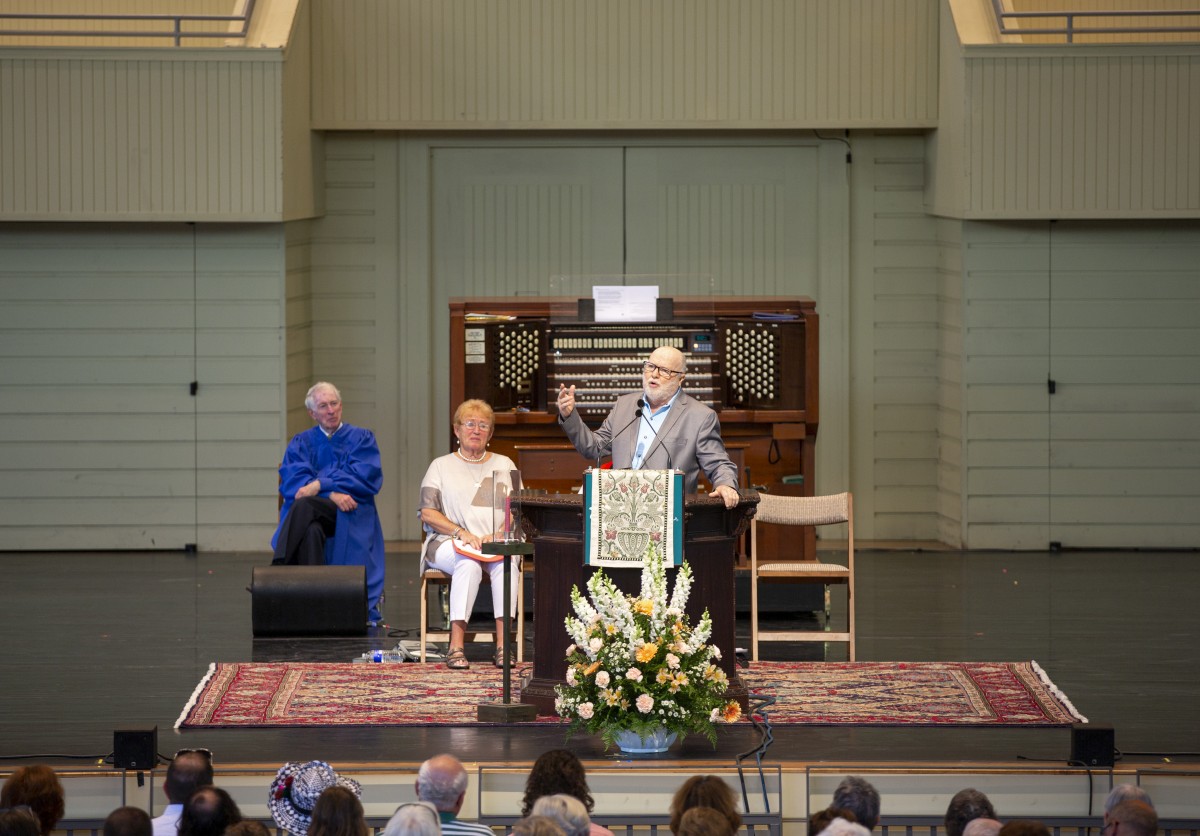
Father Richard Rohr Begins The Sermon With A Question “Did You Know That Christ Is Not Jesus’s Last Name?” At The 10:45 A.m. Morning Worship On Sunday, July 14, 2019 In The Amphitheater. Rohr Will Be The Interfaith Lecturer For Week
MHARI SHAW/STAFF PHOTOGRAPHER

“It took about eight centuries to give theological heft to what Father Francis intuited,” said Fr. Richard Rohr, OFM, at the 9:15 a.m. Thursday Ecumenical Service. “He gave subjectivity, ‘sacrality’ if you will, to everything.”

His sermon title was “Resolved from the Beginning,” and the Scripture reading was Ephesians 1:3-14. 

“Francis gave everything voice,” Rohr said. “We are not talking subject to object, but subject to subject. You can’t discover the soul in something else until you recognize your own.”

For Franciscans, the first Bible was nature, creation. 

“And as I have reminded you every day,” Rohr said, “that has been going on for 13.6 billion years. Meister Eckhart said ‘every creature is a word of God and is a book about God.’ ”

Nothing divine ever dies. 

“Christmas was already Easter; the problem was solved at the beginning,” Rohr said. “Resurrection is the logical conclusion to incarnation. Resurrection was not a one-time anomaly in Jesus. When I get all dressed up on Easter, the songs and responses are less than exciting. If you want to see people who are excited about the resurrection, go to the Orthodox.”

Rohr’s book, The Universal Christ: How a Forgotten Reality Can Change Everything We See, Hope For, and Believe, was supposed to be published in November 2018. It was delayed and John Dominic Crossan’s book, Resurrecting Easter: How the West Lost and the East Kept the Original Easter Vision, was published before Rohr’s. Crossan came to the same conclusion about Easter from art, that Rohr came to from theology. 

“There were no paintings of the Resurrection for the first six centuries of the church,” Rohr said. “You can see from the art how the Eastern church kept the original Easter vision while the Western church lost it.”

In the Western church, the paintings show Jesus alone; “touchdown Jesus,” Rohr called him, with his hands in the air saying “Hallelujah.” 

“Humans don’t tend to get excited about things that do not include them,” Rohr said.

Later, the paintings would feature some Easter lilies, “which don’t grow in Palestine,” Rohr said. There would be two stunned guards on one side of the tomb and two angels on the other, and Jesus with a white staff and banner attached.

“There was never a message on the banner,” Rohr said. “It was a giveaway that we didn’t know what the message was.”

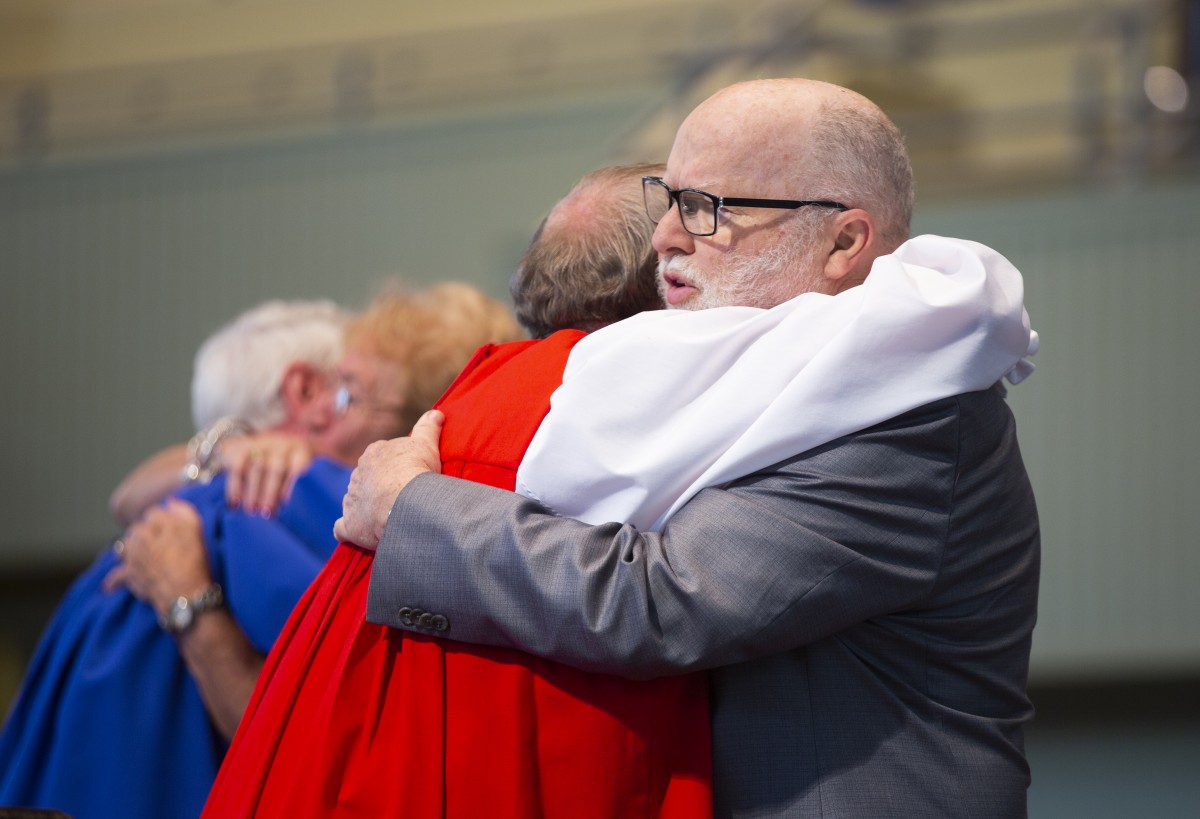
Rt. Rev. V. Gene Robinson Hugs Father Richard Rohr As Chautauquans Greet Their Eachother At The Beginning Of The 10:45 A.m. Morning Worship On Sunday, July 14, 2019 In The Amphitheater. MHARI SHAW/STAFF PHOTOGRAPHER

In contrast, in the Eastern Orthodox icons of the Resurrection, Jesus is shown rising out of Hades, pulling Adam and Eve with him followed by many other souls. Above is a cloud of witnesses.

“Until people learned to read, they studied these icons intensely because they knew there was meaning in each detail,” Rohr said. “Half the people had halos, showing they had a higher consciousness, and the other half were ordinary folks. That is an image to say ‘Hallelujah’ about.”

Rohr repeated a story from his Sunday sermon. In third grade, Rohr asked his teacher, “Sister, Jesus descended into Hell — why?” The nun replied, “to get Noah and Abraham.”

“That didn’t make sense to me,” he said. “Why were they in Hell? Both Pope John Paul II and Pope Benedict XVI have said that Hell is not a geographic place, but a state of consciousness. We got trapped in a place; we had to prove it was there, then we had to prove people were there, and they were always ‘those other people.’ Hades is simply the place of the dead, more like limbo.”

What happened to Jesus began the final chapter of history, Rohr said. 

“There should be joy, but this generation was raised with Late, Great Planet Earth and ‘Armageddon,’ ” Rohr said. “There is cynicism today because people don’t know the Gospel.”

Quoting from the movie “The Best Exotic Marigold Hotel,” Rohr said, “everything will be alright in the end, and if it is not alright, then it is not the end.”

Rohr said he wanted “(his) lightweight talk to have some heft.” 1 Corinthians 15:12-20 is a discussion of resurrection. Paul wrote that if there was no such thing as resurrection, then Christ was not raised. 

“Resurrection is a universal principle,” Rohr said. “Maybe it is our parenting, but we tend to remember threats better, and verse 14 says that our preaching is useless if Christ was not raised.”

In verse 20, Paul affirms that Christ was raised: “The first fruits of those who have died.”

“Scientists tell us that there are the same amount of atoms now as there were three seconds after the Big Bang,” Rohr said. “Those atoms keep getting rearranged, and resurrection is the facilitator of the change. Trust in a God-soaked future, soaked from the beginning, chosen from the beginning.”

The Rev. J. Paul Womack presided. Alison Marthinsen, part of a six-generation Chautauqua family, a volunteer for the Chautauqua Fund, part of the Chautauqua Choir and a member of the board of Smith Memorial Library, read the Scriptures. Barbara Hois, flute, George Wolfe, saxophone and Joseph Musser, piano, played “Two Romances and a Waltz” by Théodore Dubois and Charles Koechlin as the prelude. The Motet Choir sang “Steal Away,” arranged by Howard Helvey, as the anthem. George Wolfe served as saxophone soloist. Jared Jacobsen, organist and coordinator of worship and sacred music, directed the choir. The Alison and Craig Marthinsen Endowment for the Department of Religion provides support for this week’s services.

5.  MEDITATION 

https://youtu.be/Tkn3YVh4wu8?si=DPFqSZggd72-PWM0
6.  SHARING 
7.  INTENTIONS AND PRAYER 
Author: St. Padre Pio

O Lord, we ask for a boundless confidence and trust in Your divine mercy, and the courage to accept the crosses and sufferings which bring immense goodness to our souls and that of Your Church.

Help us to love You with a pure and contrite heart, and to humble ourselves beneath Your cross, as we climb the mountain of holiness, carrying our cross that leads to heavenly glory.

May we receive You with great faith and love in Holy Communion, and allow You to act in us, as You desire, for Your greater glory.

O Jesus, most adorable heart and eternal fountain of Divine Love, may our prayer find favor before the Divine Majesty of Your Heavenly Father. Amen.

8.  SONG
https://youtu.be/H94Gkz2YCgI?si=0wjYzh-lSKjNiI_9